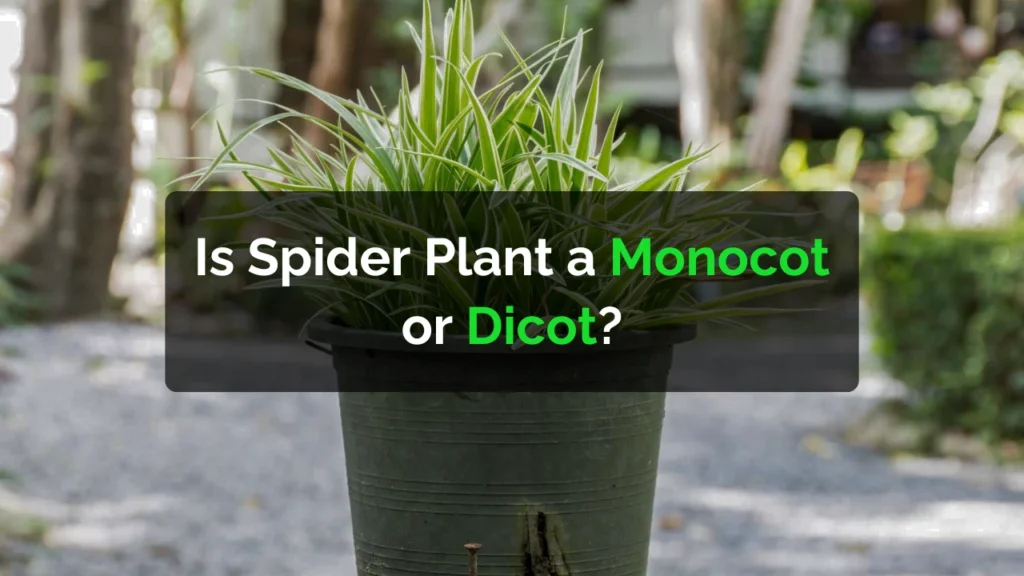
When you see a spider plant (often called Chlorophytum comosum) decorating a shelf or hanging basket, you might wonder about its classification in botanical terms. Is it a monocot or a dicot? Understanding this helps in grasping how its leaves, flowers, roots, and structure are organized. In this article, we will answer that question clearly, look at supporting traits, and compare with other plants. We will also provide some FAQs to help clarify related concepts.
What Is a Monocot and What Is a Dicot?
Before we answer for the spider plant, let’s review what distinguishes monocots and dicots (or eudicots) in flowering plants (angiosperms).
Characteristics of Monocots
- Single cotyledon (embryonic leaf) in the seed.
- Leaf venation typically parallel (veins run side by side) rather than net-like.
- Flower parts often in multiples of 3 (for instance, 3 petals, 6 tepals, etc.).
- Vascular bundles in the stem are scattered rather than arranged in a ring.
- Often no true secondary thickening (i.e., limited woodiness).
Characteristics of Dicots (Eudicots)
- Two cotyledons in the seed.
- Leaf venation often netted or reticulate (branching veins).
- Flower parts often in multiples of 4 or 5 (like 4 petals, 5 petals).
- Vascular bundles arranged in a ring inside the stem.
- Many dicots can undergo secondary growth (wood formation), especially trees and shrubs.
Modern botanical classification has refined these groups (for instance, dicots are more precisely “eudicots” in molecular phylogenies), but for general reference, these traits remain useful.
Is Spider Plant a Monocot or a Dicot?
The spider plant (Chlorophytum comosum) is a monocot.
Here’s how we know:
- Leaf structure and venation
The leaves of the spider plant are long, narrow, and have parallel veins a hallmark of monocots. - Flower structure
The flowers of C. comosum show six tepals (or segments) a multiple of three consistent with monocot floral patterns. - General taxonomy
Chlorophytum comosum belongs to the family Asparagaceae, within an order (Asparagales) largely composed of monocots. - Botanical sources
Botanical references list Chlorophytum under monocot lineages (Asparagales), aligning it with typical monocot plants.
Therefore, all major structural and taxonomic evidence point to spider plant being a monocot.
Why It Matters: Practical Insights for Plant Care
Knowing that the spider plant is a monocot gives insight into its growth and care:
- Propagation: Spider plants often propagate via “plantlets” or “pups” on long stalks (inflorescences). This vegetative propagation is typical in many monocots with rhizomes or stolons.
- Growth habit: Its leaves don’t thicken like woody shrubs; they remain slender and flexible, consistent with monocot habit.
- Stem structure: Monocot stems typically lack strong secondary thickening (woodiness), meaning the plant won’t develop hard woody trunks under typical indoor conditions.
Comparisons — Spider Plant vs. a Dicot Example
| Feature | Spider Plant (C. comosum) | Dicot Example (e.g., Rose) |
|---|---|---|
| Cotyledons | One (monocot) | Two (dicot) |
| Leaf veins | Parallel | Branched (netted) |
| Flower parts | Multiples of 3 | Often 4 or 5 multiples |
| Stem vascular bundle | Scattered pattern | Ring structure |
| Secondary growth | Minimal | Possible in woody dicots |
This contrast helps clarify how spider plant fits cleanly into the monocot category.
FAQs
Are all indoor plants monocots?
No, indoor plants can be monocots or dicots. For example, spider plants and orchids are monocots, while rubber plants and pothos are dicots.
How can I tell if a plant is a monocot or a dicot just by looking at it?
Look at the leaves and flowers. Monocots usually have straight, parallel veins and flower parts in groups of three. Dicots often have branching veins and flowers with four or five petals.
Does being a monocot change how I care for my spider plant?
Not much, but it helps you understand why the plant grows the way it does. Its soft, grassy leaves and runner-like stems are typical monocot traits.
What other plants are similar to the spider plant?
Other monocot houseplants include peace lily, snake plant, and dracaena. All have similar leaf patterns and simple growth structures.
Can the classification of a plant ever change?
Yes, scientists sometimes update plant classifications as they study plant DNA and discover new relationships. But the spider plant is firmly grouped among monocots.
Conclusion
The spider plant is a monocot. Its leaf structure, flower pattern, and family background all confirm this classification. Knowing this helps you better understand how it grows and how to care for it. The spider plant’s graceful, ribbon-like leaves and easy care make it a perfect example of how beautiful and adaptable monocot plants can be.